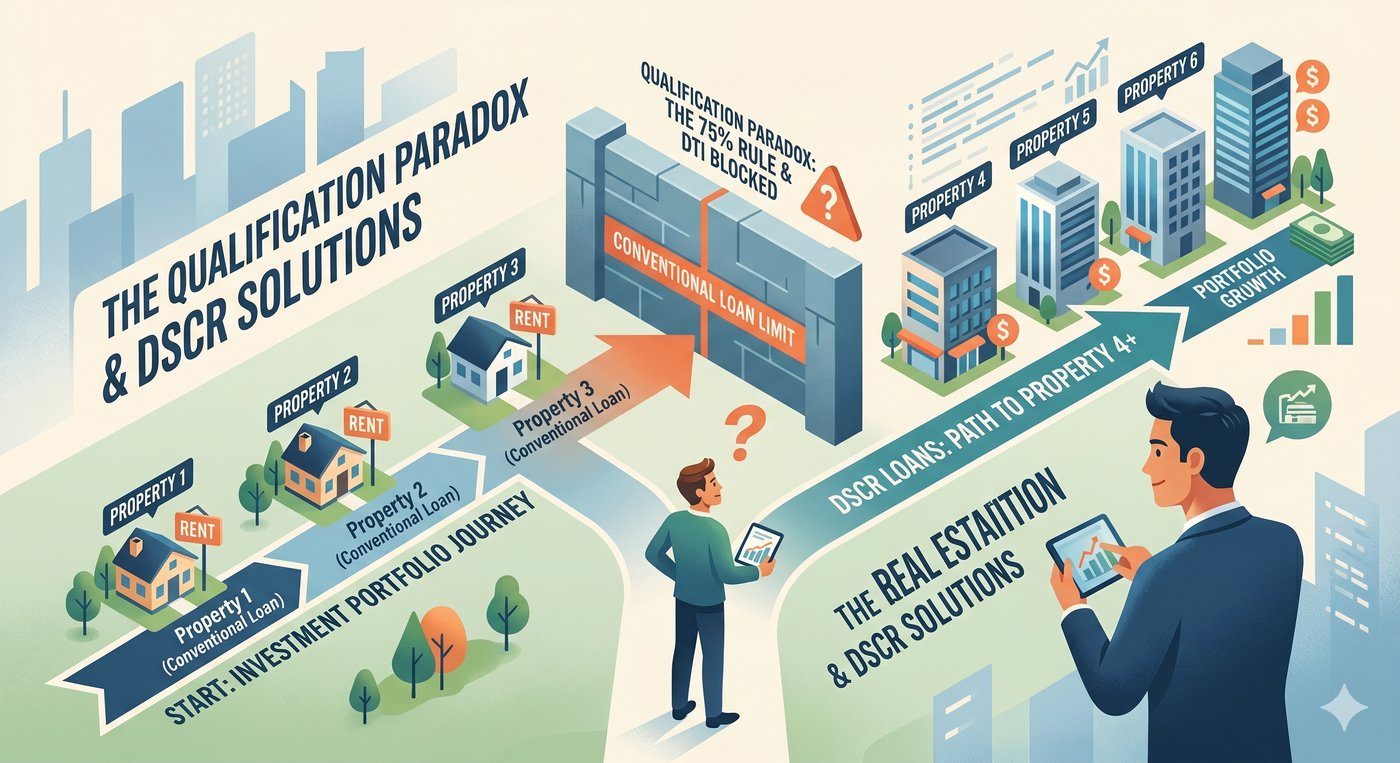
I had a conversation last week that I've had probably 200 times in the past year. Sharp investor, owns three rental properties free and clear, wants to buy number four. Good income, good credit, plenty of cash. Should be straightforward, right?
Except it wasn't. Because somewhere between property three and property four, the underwriting rules changed on him and nobody told him they would.
He'd been using conventional Fannie Mae loans for the first three properties. Made sense. Agency terms, maximum LTV, 30-year fixed. The Golden Tickets. But now he's sitting on $800,000 in equity across those three properties, all paid off, and the lender he's been working with just told him he doesn't qualify for another conventional loan because his debt-to-income ratio is too high.
Wait, what? He doesn't have any debt. That's the whole point.
Here's what happened. And if you're building a portfolio, this is the exact scenario you need to understand before you hit it yourself.
The 75% Rule (And the Rule That Comes After It)
When you're qualifying for a conventional loan on an investment property, Fannie Mae has a specific way they calculate your rental income. And there are actually two versions of the calculation, depending on where the property is in its life cycle.
For a property that's brand new in your portfolio, or one you just bought and haven't filed a tax return on yet, they'll typically use 75% of the market rent from the appraiser's rent schedule or the signed lease. The other 25% is assumed to cover vacancy, maintenance, and all the things we know eat into cash flow.
Sounds reasonable. Except here's the catch: they're taking 75% of the rent, but they're counting 100% of your PITIA if the property has a mortgage. Principal, interest, taxes, insurance, association dues. The full amount.
So let's say you've got a property that rents for $2,000 a month. Fannie's going to give you credit for $1,500 of qualifying income. But if your PITIA on that property is $1,600, you're showing a $100 monthly loss on paper, even if you're actually cash flowing $300 after the real expenses.
For a property that's been on your tax return for a year or more, they pivot to a different calculation. They use the net rental income from Schedule E, with add-backs for depreciation, mortgage interest, taxes, insurance, and HOA. So depreciation, on its own, doesn't kill your qualifying income. They add it back. Same with interest. The number that actually matters is what's left after operating expenses (repairs, management, utilities, vacancy) hit the bottom line.
Either way, the gross rent you're collecting and the qualifying income they give you credit for are two very different numbers.
How That Plays Out Across a Portfolio
Now multiply that across three properties. Even if every single one is cash flowing in reality, you could be showing thin or negative qualifying income on paper that's pressuring your debt-to-income ratio.
My guy with the three paid-off properties? His Schedule E across all three was thin. Some real repair years. A stretch of vacancy on one of them. After the add-backs, his net operating income just wasn't producing meaningful qualifying credit. And without mortgages on the properties, there was no PITIA on the liability side to balance the calculation either. The whole thing kind of collapsed on him. He was trying to qualify for property four on his W-2 alone, with three rentals that were technically generating cash but giving him almost nothing on the application.
He did everything right from a wealth-building standpoint and got penalized for it from a qualification standpoint.
The Qualification Paradox (And Why It Drives Me Crazy)
Real estate investing is one of the few wealth-building strategies where getting better at it can actually make it harder to keep going, if you don't understand how the financing side works.
You pay down debt, you build equity, you write off operating expenses. All smart moves. But if you're not planning for how that affects your next transaction, you can box yourself out of the conventional loan market entirely.
And here's what makes it even more frustrating: the solution isn't to stop doing those things. It's to know which loan products to use when, and how to structure your qualifications so you're not fighting the guidelines every time you want to buy.
For the investor I was talking to, the answer was pretty straightforward once we looked at the full picture. He needed to switch to DSCR loans for his next few purchases. Debt Service Coverage Ratio loans qualify based on the property's income, not his personal income. The underwriter looks at the rent the property will generate, compares it to the mortgage payment, and if the ratio works (usually 1.0 or higher, meaning the rent covers the debt), you're approved.
No personal tax returns. No W-2. No worrying about what your Schedule E shows or whether you've got three mortgages or ten mortgages already on the books.
Is the rate a little higher than conventional? Yes. DSCR loans typically price above agency, though the exact spread moves with the market, the property, and your LTV. In monthly terms on a typical investment loan, the difference is usually manageable. But if it's the difference between buying and not buying, the math is pretty clear. You're not paying that rate forever. You're paying it until you can refinance into something better, or until you've structured your qualifications in a way that gets you back into the conventional market.
The Part That Actually Bothers Me
It's not that this investor made a mistake. It's that nobody told him this was coming.
He bought property one with a conventional loan. Worked great. Bought property two the same way. Bought property three the same way. And then at property four, the rules changed and he had no idea why.
Except the rules didn't actually change. They were always there. He just didn't know to ask about them because most lenders don't have this conversation until you're already in the middle of an application and it's too late to do anything about it.
This is exactly why we spend so much time on education. If there's a claim to fame at Ridge, it's that we're having these conversations on transaction one, not transaction four. We're walking through what your qualifications look like now, what they'll look like after this purchase, and what your options are going to be for the next one.
Because here's the thing: if you know you're going to hit the debt-to-income wall at property four, you can plan for it. Maybe you use conventional loans for properties one and two, then switch to DSCR for three and four while you let your rental income season on the tax returns. Or maybe you keep one property with a mortgage so the calculation works in your favor. Or maybe you separate qualifications between you and a spouse so you've got 20 Golden Tickets instead of 10.
There are a dozen ways to structure this. But you can't structure it if you don't know it's coming.
So What Does This Mean for You Right Now?
If you already own investment properties, pull your most recent loan application and look at how your rental income is being calculated. Is the underwriter using the lease, the appraiser's rent schedule, or Schedule E? What's the qualifying number they came up with? How does it compare to what those properties are actually doing in real life?
And if you're planning to buy in the next 6 to 12 months, have this conversation now. Not when you're under contract. Now. Ask your lender to run your qualifications as if you're buying today, then ask them to run it again as if you've already closed on this next property and you're buying the one after that.
You want to know where the ceiling is before you hit your head on it.
The other thing I'd say: if you bring up plans to buy multiple properties over the next few years and the response you get isn't a real conversation about how your qualifications will change and which products fit which stage, that's worth paying attention to. You want someone thinking three transactions ahead, not just one.
This isn't a one-transaction business. You're building a portfolio. The financing strategy has to match that, and it has to evolve as your situation evolves. If the financing conversation isn't already thinking about transaction five when you're closing on transaction two, that's a gap worth closing.
The investor I was talking to is moving forward with a DSCR loan on property four. We walked through the numbers, looked at what the rate difference would actually mean in monthly terms, and he realized pretty quickly that the payment difference wasn't the thing keeping him from building wealth. Not buying was.
He's also now got a plan for properties five, six, and seven. He knows when he'll be able to get back into the conventional market, he knows what his tax returns need to show, and he knows which properties to keep paid off versus which ones to keep leveraged.
That's the difference between hitting a wall and building a portfolio. It's not about having perfect credit or unlimited income. It's about understanding how the system works and structuring your qualifications so the system works for you instead of against you.
Because the math will not lie. And if you know the math, you can plan around it.
Happy investing,
Caeli