The All In One Loan™ is a mortgage replacement that works like a checking account. Your paychecks and rents are deposited straight into the loan, every deposit lowers what you owe that same night, and you can still spend the money the way you spend from checking. In lending terms, it is a first-lien home equity line of credit.
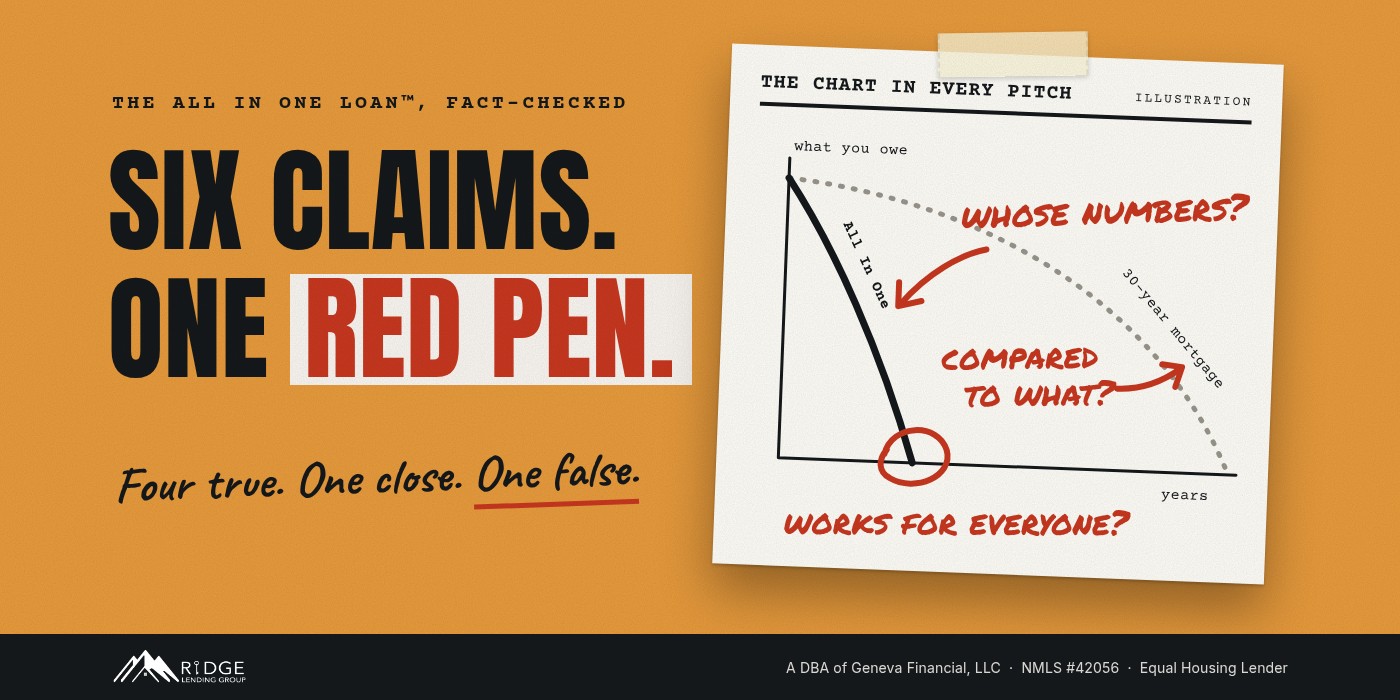
It is usually pitched with a chart where a 30-year mortgage disappears in about nine years.
The chart is usually real. What tends to be missing is whose numbers it uses, what it is being compared against, and who the loan doesn't work for.
So this page takes the six things you'll hear most about the loan and checks each one against a worked example. Each gets a verdict and math you can check yourself.
The short answers
- "Your first payment on a regular mortgage barely touches what you owe." True.
- "It's a mortgage and a checking account in one." True.
- "Your idle cash goes to work." True, and smaller than it sounds.
- "It can pay off a 30-year mortgage in about nine years." True in our example. It is not a forecast.
- "You could do the same thing by prepaying a fixed-rate loan." Nearly. In our example the fixed loan finishes slightly ahead, but the money you prepay is locked in the property.
- "It works for everyone." False.
The reasoning and the numbers for each one are below.
The example, so you can check us
Every number below comes from one example:
- A $400,000 loan balance.
- A 30-year fixed mortgage at 6.75%.
- An All In One Loan at 7.50%. That is a higher rate, on purpose.
- $25,000 a month deposited, half on the first and half mid-month.
- $20,000 a month spent.
- So $5,000 is left over every month.
This is an illustration, not a quote. The example holds the All In One rate still for the whole run. The real rate is adjustable and will move. Your balance, income and spending are not these, so your result will not be either.
1. "On a regular mortgage, your first payment barely touches what you owe."
Verdict: true.
The payment on that fixed loan is about $2,594 a month. In the first month, $2,250 of it is interest and about $344 goes to principal.
Nobody is cheating you. That is how any amortizing loan works. Interest is charged on what you owe, and you owe the most on day one. The split improves a little every month, and near the end almost the whole payment is principal.
Paid on schedule for all 30 years, that loan costs about $534,000 in interest.
2. "It's a mortgage and a checking account in one."
Verdict: true.
The All In One is a first-lien home equity line of credit with a checking account built in. It replaces your mortgage. It is not a second loan sitting behind the one you have.
Your paychecks, rents and business income are deposited into it, and every dollar pays down the balance the night it arrives. You still spend the way you do now: debit card, checks, bill pay.
3. "Your idle cash goes to work."
Verdict: true, and smaller than it sounds.
A fixed mortgage charges interest once a month. The All In One charges interest on each day's balance.
In the example, $12,500 lands on the first. That night, interest is charged on $387,500, not on $400,000. As the month's bills go out, the balance drifts back up. That is fine. The money lowered your interest for every day it sat there.
In a regular checking account, cash waiting to be spent does nothing for you. Here it holds the balance down while it waits.
On its own, that effect is modest. The next one is what moves the loan.
4. "It can pay off a 30-year mortgage in about nine years."
Verdict: true for this example. It is not a forecast.
The $5,000 left over each month never leaves the loan. In month one the balance falls by about $2,500, where the fixed loan's first payment took off $344. Then it repeats on a smaller balance, every month.
Run it out with the rate held at 7.50%, and the loan is gone in about 110 months, a little over nine years, with about $148,000 in interest. The fixed loan paid on schedule costs about $534,000 in interest.
That result belongs to one set of habits: steady deposits and $5,000 left over every single month. Change the habits and the result changes with them.
5. "You could do the same thing by prepaying a fixed-rate loan."
Verdict: nearly. In this example, slightly better.
This is the question most All In One pitches skip, and it is the right one to ask.
Take the same $5,000 a month and send all of it at the fixed loan. It is paid off in about 107 months. That is three months sooner than the All In One in this example. Because the fixed rate here is lower, the interest is lower too: about $133,000 against about $148,000.
So on speed and on interest, the disciplined fixed-rate borrower in this example comes out slightly ahead. What the All In One offers in exchange is access.
Every dollar you prepay on a fixed loan is locked inside the property. To get it back you refinance or you sell. In the All In One, the principal you have paid down is still your available line the same day: the next down payment, a new roof, three months of vacancy.
For an investor, that is the real question. Is same-day access to your own paid-down principal worth the difference to you? For some investors it clearly is. For some it isn't.
6. "It works for everyone."
Verdict: false.
The All In One is a poor fit if any of these describe you:
- What's left each month is smaller than the interest. Then the balance grows. In the example, monthly interest starts near $2,500. Leave $1,000 a month and the balance rises by about $1,500 a month.
- You want a payment that never changes. The rate is adjustable. The example holds it still, and real life won't.
- Your income arrives in a few large lumps. The loan rewards money moving through the account all year.
- An open line of credit would get spent. Paid-down principal you can draw again only helps if you leave it alone until you need it.
With thin residual income, a fixed loan usually wins, and we will tell you that.
Four things a chart won't show you
- Your result depends on your habits. Two investors with the same balance and the same rate can land in very different places, because one has steady deposits and real money left over and the other doesn't.
- Already have a low fixed rate? Don't decide on the rate alone, in either direction. Compare the whole package: the loan you keep, plus whatever second line you would open for a down payment, plus the cash you keep idle, against one All In One. Some investors keep the low-rate loan on a rental and put the All In One on their home.
- Taxes. Paying a rental's loan down faster changes how much interest you pay, which can change your tax picture. Ask your CPA.
- Where it's available. Owner-occupied All In One loans are not available in Texas, and Ridge does not lend in New York.
What to do with this
- Run your own numbers in the All In One simulator. Then run them again with a higher rate and less left over. If it only wins in the hopeful version, you have your answer.
- Go deeper in the All In One masterclass, or read the All In One Loan page.
- Book 20 minutes with us. We'll put your balance, income and what's left over through the simulator with you. If the answer is to keep the mortgage you have, that is what you will hear.
Have three minutes and want a laugh?
We made a parody 1990s infomercial about this loan, with a fact-checker standing next to the salesman. It uses the same example as this page. Watch it on our YouTube channel.
Illustrative example only: $400,000 balance; $25,000 a month deposited; $20,000 a month spent; All In One rate 7.50% held constant; 30-year fixed 6.75%. The All In One rate is adjustable, and actual results vary with balance, income, spending and rate. Educational content only; not a rate quote, an offer of credit or a commitment to lend. Not all applicants will qualify. All In One Loan™ is a trademark of CMG Financial. Caeli Ridge, NMLS #9556. Ridge Lending Group is a DBA of Geneva Financial, LLC, NMLS #42056. Equal Housing Lender. Licensed in 49 states; not available in New York. All loans subject to credit and underwriting approval. NMLS Consumer Access: nmlsconsumeraccess.org. Talk to your CPA about any tax questions.